


Gummy Science
Are Gummy Vitamins Halal or Kosher? What Certification Covers
Pectin gummies skip gelatin, the usual halal or kosher concern, but certification covers the whole product. We hold neither. How to check any brand's...

Short answer: yes. In fact, we put both in the same gummy on purpose, and so do a lot of the immune products on the shelf next to ours. There is no rule that says these two have to be taken apart, and there is a good reason they keep showing up together.
Quick facts
Vitamin C and zinc are two of the most studied nutrients for normal immune function. They do different jobs, which is exactly why they work well side by side rather than stepping on each other.
Neither one blocks the other. The old worry people have is that combining nutrients causes an "absorption fight," and there are a few real cases of that (calcium and zinc at very high doses, for example). Vitamin C and zinc are not one of them. They are routinely combined in the same daily supplement for that reason.
This is the part people overthink. For a daily immune supplement, consistency beats clock-watching. The nutrients build up with regular use, so the best time to take them is the time you will remember.
Two small things worth knowing:
Total daily zinc is the number to watch.
Zinc has a well-established upper limit: 40 mg per day for adults. The NIH Office of Dietary Supplements puts it this way: "The Tolerable Upper Intake Level for zinc is 40 mg for adults, and it ranges from 4 to 34 mg for infants, children, and adolescents, depending on age" (ods.od.nih.gov). The same fact sheet notes that sustained intakes above that limit can affect copper status. Add up the zinc across everything you take and stay under that number.
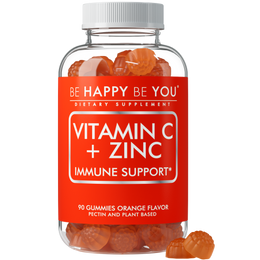
For context, one serving of our Vitamin C + Zinc gummy has 5.5 mg of zinc (as zinc citrate), straight off the supplement facts panel. At a sensible daily dose there is nothing to manage. The people who run into trouble are the ones stacking a high-dose zinc pill on top of a multivitamin on top of a cold lozenge, and never adding it up.
Vitamin C is even more forgiving. The NIH's own vitamin C fact sheet states: "The Tolerable Upper Intake Level for vitamin C ranges from 400 to 2,000 mg, depending on age" (ods.od.nih.gov), and for adults that top number is 2,000 mg a day. The worst most people get from overdoing it is an upset stomach. Our serving is 90 mg (as ascorbic acid), the full Daily Value.

The reason we combine them is simple: it removes a decision. Instead of remembering two bottles and doing the dose math yourself, you take one serving and you are done for the day, both nutrients at sensible levels, no pills to swallow.
Each serving is 90 mg of vitamin C and 5.5 mg of zinc, with 2 grams of total sugars and a real orange flavor. It uses pectin rather than gelatin. If you want the longer version of how we think about daily immune support, that is on its own page.
Take vitamin C and zinc together whenever you will remember, with food if your stomach is picky, and keep an eye on your total daily zinc across everything you take. Do that and the "should I space them out" question answers itself: you do not need to.
Reviewed on September 4, 2026.
This article is general information, not medical advice. Talk to your healthcare provider before starting any supplement, especially if you are pregnant or nursing, take medication, or have a health condition.
These statements have not been evaluated by the Food and Drug Administration. This product is not intended to diagnose, treat, cure, or prevent any disease.
Yes. There is no meaningful absorption conflict between the two, which is why they are so often combined in a single immune supplement. Taking them together is fine.
Either works. Zinc on an empty stomach is the most common cause of that queasy feeling some people get from vitamins, so if your stomach is sensitive, take it with a little food. At a normal daily serving most people are fine without.
The upper limit for adults is 40 mg of zinc per day, per the National Institutes of Health. One serving of our Vitamin C and Zinc gummy has 5.5 mg. The thing to watch is your total zinc across every supplement you take.
For daily support, yes, consistency is what matters. Your body does not store zinc well and clears extra vitamin C, so a steady daily amount does more than an occasional large one.
Food first is always a good rule. A supplement is a simple way to cover the gaps on days your diet falls short, which for most people is more days than they would like to admit.
Whenever you will remember, which for most people is the morning with breakfast. There is no clinically required time. If zinc on an empty stomach has ever left you queasy, take them with a little food.
For daily support you do not need to. One serving covers it, and your body clears extra vitamin C rather than storing it. If you do split doses, keep an eye on your total daily zinc across everything you take, since the 40 mg upper limit is what matters.
At a normal daily serving there is no interaction to manage. The known ones show up at high doses: sustained high zinc can lower copper, and large amounts of zinc, iron and calcium together compete for absorption.
*These statements have not been evaluated by the Food and Drug Administration. This product is not intended to diagnose, treat, cure, or prevent any disease.
One useful read at a time on gummies, ingredients, and routines that stick. No spam, unsubscribe whenever.
How is your visit going so far?
What best describes it?
Thank you. That helps.